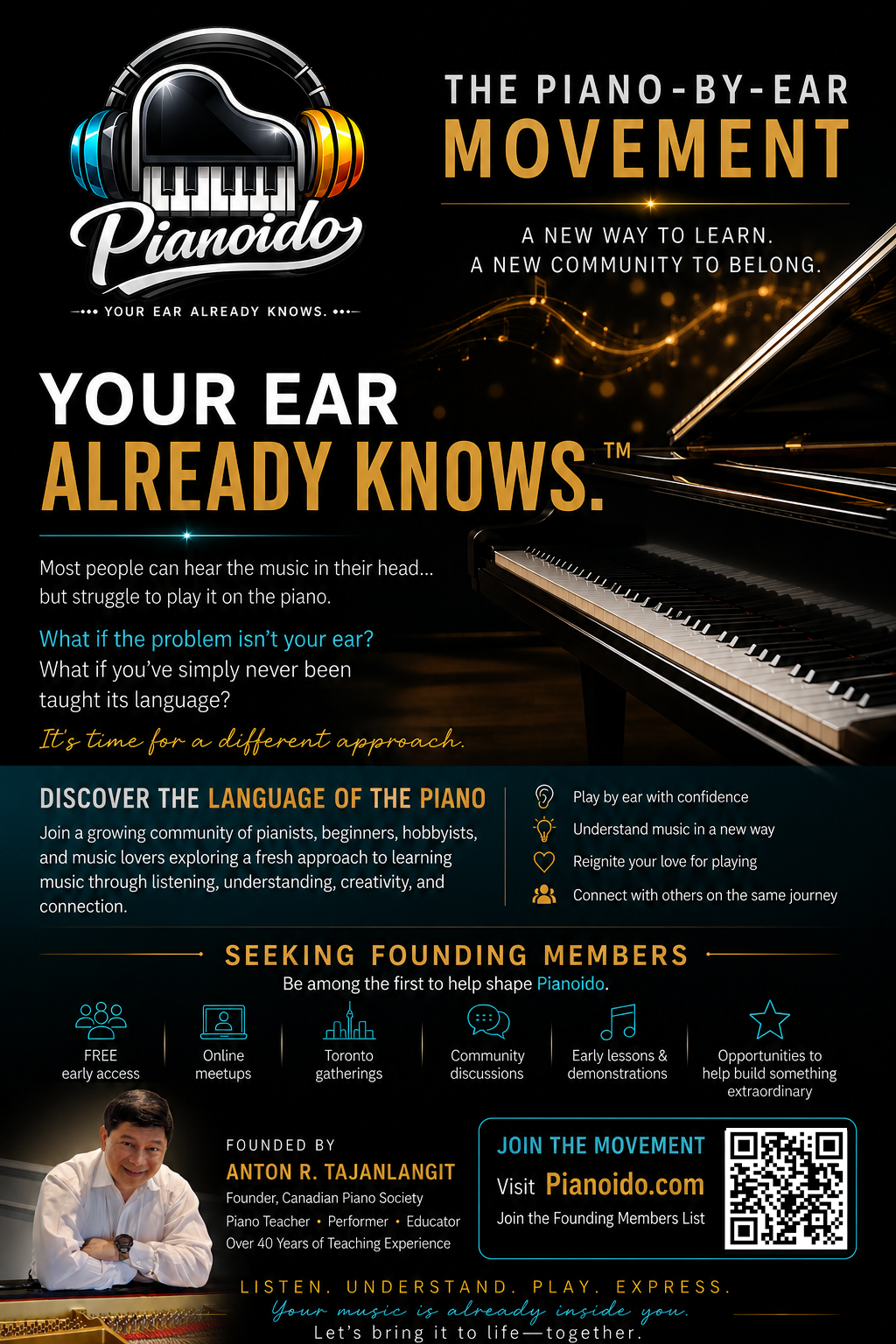
Pianoido is a coined word rather than one with a historical dictionary etymology, so its meaning comes from how its parts are constructed.
The word can be understood as being formed from two elements:
- Italian: piano – meaning "soft" or "quiet." It comes from pianoforte ("soft-loud"), the instrument's original name because it could play both softly and loudly.
-
Spanish: oído
- The Spanish word oído (with an accent on the i) means hearing, the sense of hearing, or ear.
- It comes from the verb oír ("to hear") and from the Latin audire ("to hear").
- Pronounced approximately oh-EE-doh.
Pianoido (pee-ah-noh-WEE-doh)
noun (proper noun)
- A comprehensive approach to learning the piano primarily through the ear rather than by dependence on written notation.
- An educational movement that teaches musicians to understand the "language of the piano," enabling them to recognize patterns, improvise, accompany, compose, and play by ear with confidence.
- The international community and membership program founded by Anton R. Tajanlangit dedicated to developing intuitive, ear-based pianists.